
What we do
When someone buys a book or subscribes to a journal, that’s the primary market. The rightsholder gets paid, the creator receives royalties.
But what happens when a school photocopies a chapter for students, a business scans pages for training materials, or a university creates course packs? That’s secondary use: copying that happens after the original purchase.
Without us, rightsholders would need to manage secondary use licensing themselves. We simplify the process by collecting licensing fees from organisations that photocopy and scan published works and distributing the revenue back to rightsholders. With a Tāwhia Copyright Aotearoa licence, schools, organisations, and businesses can copy more than the law permits, legally and without risk.
Our licensing, education, advocacy, and support serves licence holders, rightsholders, and the wider creative community.
What’s covered
Our licences cover photocopying and scanning from physical books, journals, and magazines, up to 10% or one chapter of any work.
Licences currently cover print and physical formats. In 2026, Tāwhia will be rolling out the inclusion of a range of digital materials to the licensing schemes.
How creators receive payment
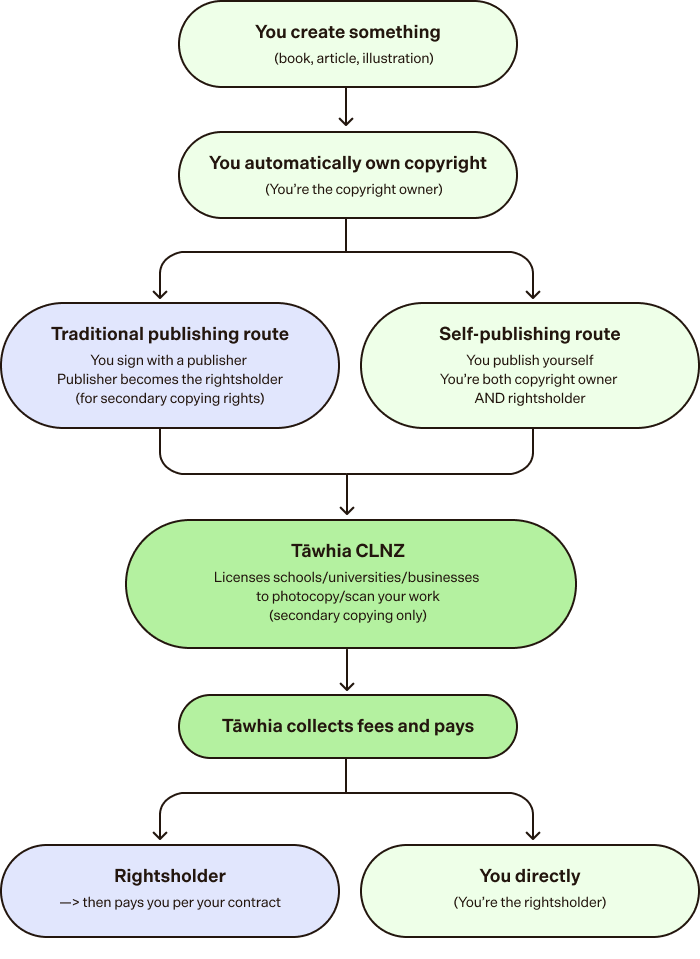
For traditionally published work, we pay rightsholders (typically publishers, authors, or visual artists). For self-published work, we pay creators directly. Payment is calculated based on copying records and licensing revenue collected in each sector. For full details, see our Distribution Policy.
How copyright flows to payment
“Quote lorem ipsum dolor sit amet, consectetur adipiscing elit, sed do eiusmod tempor”
-Sam Irvine